Accessory dwelling units ADUs are one of the fastest-growing permit categories in the United States. California, Florida, Texas, and dozens of other states have relaxed ADU rules to increase housing supply. But getting an ADU permit still requires a proper site plan, and the requirements are more detailed than a simple fence or shed permit.
I’m Engineer Wasim. My team prepares ADU site plans for homeowners and builders across the country. This guide covers what an ADU site plan must include, when a PE stamp is needed, and how to check feasibility before ordering.
What Is an ADU?
An ADU (Accessory Dwelling Unit) is a secondary residential unit on the same lot as a primary home. It functions as an independent living space with its own kitchen, bathroom, and sleeping area.
Common ADU types:
- Detached ADU — a separate structure in the backyard
- Garage conversion ADU — converting an existing attached or detached garage
- Attached ADU — addition connected to the primary home
- Junior ADU (JADU) — converted space within the existing home
- Backyard cottage or guest house
ADU rules vary significantly by state, city, and county. California has state law that overrides local restrictions for most properties. Florida rules vary by county. Many cities have ADU-specific development standards.
What an ADU Site Plan Must Show
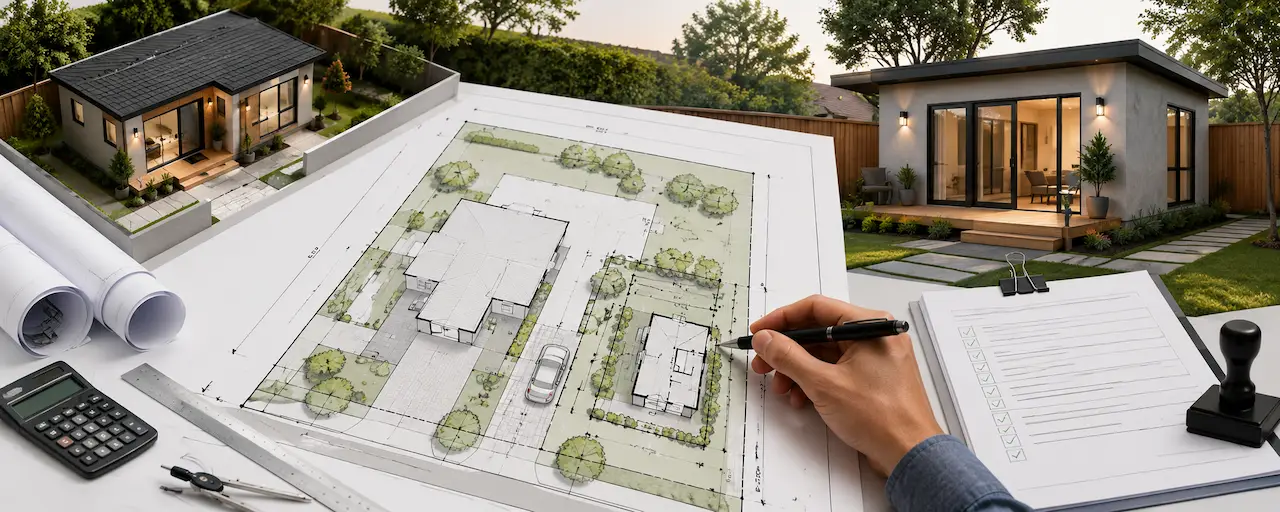
An ADU site plan is more detailed than a simple residential permit site plan. Most jurisdictions require:
- Property boundaries with dimensions
- Existing primary home with dimensions and setbacks
- Proposed ADU location clearly labeled with dimensions
- All setbacks from the ADU to property lines ADU setbacks are often different from principal structure setbacks
- Existing and proposed driveway — many jurisdictions require additional parking for an ADU
- Parking spaces — number, dimensions, and location
- Utility connections — water, sewer (or septic), and electrical service
- Lot coverage calculation — ADUs add to impervious surface
- Access routes — pedestrian access to the ADU from the street
- Any existing easements
- Scale, north arrow, title block
For ADU plans on septic systems, the site plan must show the septic tank and drain field with required setbacks from the new structure.
See our ADU Plans page for service details.
ADU Feasibility Checker
Before ordering a site plan, use our ADU Feasibility Checker to review whether your property may support an ADU based on:
- Lot size and available yard space
- Existing structure location
- Setback requirements
- Parking availability
- Zoning classification
This helps you understand the constraints before committing to the permit process.
When Is a PE Stamp Required for an ADU?
PE stamp requirements for ADUs vary by jurisdiction:
- New detached ADU construction — many jurisdictions require a PE or architect stamp for a new structure
- Structural modifications — if the garage conversion requires structural changes (removing walls, adding beams), PE or structural engineer review is required
- Drainage concerns — if your lot has drainage challenges, a grading and drainage plan may require PE certification
In Florida, ADU permits typically require more documentation than other states. For Florida ADU site plans, visit Site Plans FL.
California ADU Site Plans
California passed major ADU legislation (SB 9, AB 68, AB 2221) that significantly loosened local restrictions. Most single-family residential lots in California can now add at least one ADU. However:
- The site plan must still show all required setbacks (typically 4 feet from rear and side lines for detached ADUs in most CA cities)
- Parking requirements may be waived in certain transit-accessible areas
- City-specific design requirements still apply
Use our Site Plan Requirements Checker for your specific California city.
Common ADU Site Plan Mistakes
Not showing parking.
Many cities require one additional off-street parking space per ADU bedroom. Missing parking on the plan triggers a correction.
Wrong setbacks.
ADU setbacks are often different from primary structure setbacks. Applying the wrong setback standard is a common error.
Lot coverage not calculated.
ADUs add to total impervious surface. Exceeding the maximum is a rejection reason.
Utility connections missing.
Show how the ADU will connect to water, sewer (or septic), and electrical service.
Ready to get your ADU site plan?
Start My ADU Plan | Check ADU Feasibility | Get a Quote
Also read: